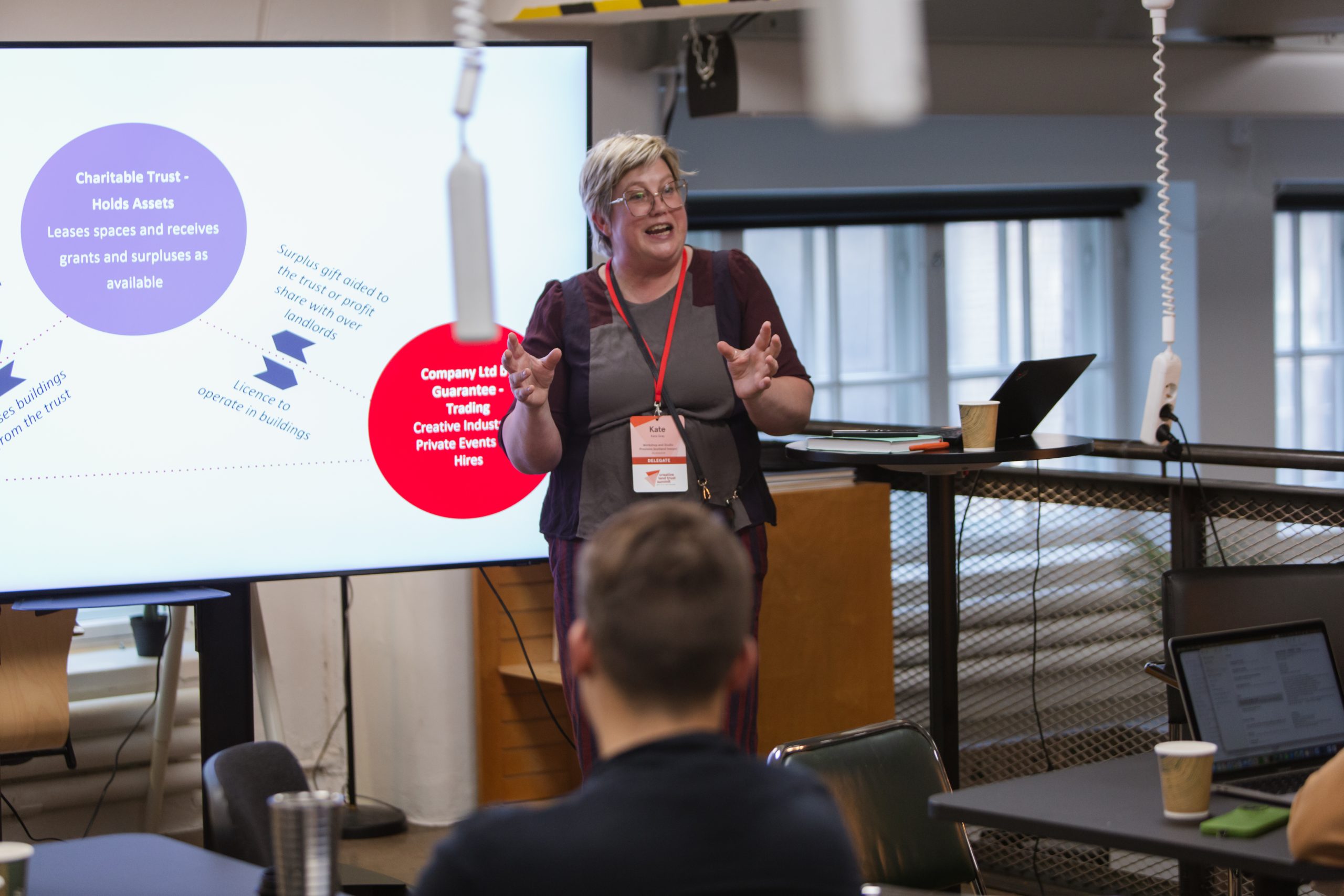
In September, I travelled to Helsinki to take part in the second Creative Land Trust Summit, bringing together people from across the world who are working to secure affordable, long term space for artists, creative organisations and cultural communities.
The Summit took place at Kaapeli, a former Nokia cable factory that has been transformed into one of Europe’s most significant cultural centres. Today, hundreds of artists, creative businesses and cultural organisations work from the building, with affordable space secured through a model that is publicly funded but operationally independent.
For Wasps, there was something particularly valuable about being part of this international conversation. We are often focused on the immediate challenges of running our buildings, supporting our tenants and securing the future of our own spaces. Stepping outside Scotland gave me an opportunity to look at those challenges differently – and to see just how widely they are shared.
A global challenge
The pressures facing artists and creative organisations are remarkably similar wherever you are.
Rising property values, increasing rents, development pressure and insecure tenure can all make it difficult for artists to remain in the places where they have established their practices and communities. At the same time, places increasingly recognise the contribution that culture makes to the identity, economy and quality of life.
The question, therefore, is not simply how we find space for artists, it is how we protect space for creativity for the long term.
That distinction is important.
Temporary or meanwhile space can be incredibly valuable. It can provide opportunities where none existed before and can help artists and organisations establish themselves. But if the building is ultimately going to be sold or redeveloped, the underlying problem of security has not been solved.
The Creative Land Trust movement is interested in what happens when we start to think differently about ownership and stewardship – taking buildings out of the speculative property market and creating structures that allow them to remain affordable and available for culture over generations.
What can we learn from Helsinki?
Kaapeli is an brilliant example of what can happen when a city makes a long-term commitment to cultural infrastructure.
The former cable factory has been in cultural use for 35 years and is now home to hundreds of creative organisations and artists. The model has evolved over time, rather than being delivered as a single, fixed solution.
What struck me was that the conversation was not about finding one perfect model. Instead, it was about learning from different approaches and understanding what might work in different places.
The Summit brought together practitioners, funders, policymakers and people working across property, housing and community development. There were examples from the USA, Canada, Europe, Australia and elsewhere, each operating in very different political and property environments. But there was a common recognition that cultural space needs to be treated as infrastructure.
If we believe that artists and cultural organisations are important to the life of our cities and communities, then the spaces in which they work need to be treated as something worth protecting – not simply as another part of the commercial property market.
More than workspace
One of the conversations I was particularly pleased to contribute to was around artist housing.
For many artists, the distinction between where they live and where they work is not straightforward. The cost of housing can determine whether someone can afford to maintain a studio. A lack of affordable housing can force artists out of the communities in which they have built their practices. Also, different generations experience this differently.
This is why the conversation about creative space increasingly needs to be broader than studios alone.
At the Summit, I moderated a discussion with colleagues from Bow Arts in London, Artspace in Minneapolis and Artist Space Trust in California about the case for artist housing – looking at why affordable homes matter alongside workspaces, and what partnerships and funding models might make this possible.
For Wasps, this is an important area of future thinking. We have decades of experience in providing affordable creative workspace, but the wider conditions in which artists live and work are changing. If we want creative communities to thrive, we need to think about those conditions in the round.
Different models, shared purpose
Another important lesson from Helsinki was that there is no single model for securing creative space.
Some organisations own their buildings. Others work in partnership with local authorities or other public bodies. Some use philanthropic investment, some social finance, some conventional borrowing, and many combine different sources of funding.
The common factor is not the financial structure itself. It is the purpose of the ownership.
The aim is to create a form of stewardship that puts the long-term cultural value of a building alongside, and sometimes ahead of, its short-term financial value.
This is where Creative Land Trusts can be particularly powerful. They create a mechanism through which property can be held for a defined public or community purpose, allowing the organisation responsible for the building to focus on long-term stewardship rather than constantly having to respond to changes in the property market.
That idea resonates strongly with Wasps.
Our buildings are not simply properties. They are the physical infrastructure that makes our work possible. They are places where artists build careers, businesses grow, communities form and audiences encounter new work.
The importance of philanthropy
One of the most striking differences between the UK and some of the international examples we heard about was the role played by philanthropy.
The Helsinki Summit itself was supported by a group of major philanthropic organisations, including the Kenneth Rainin Foundation, William and Flora Hewlett Foundation, Bloomberg Philanthropies and others, Wasps did not have to pay for my engagement with it.
There was a strong recognition that securing permanent cultural infrastructure often requires forms of patient capital and investment that are difficult to generate through earned income alone.
That does not mean philanthropy replaces public investment.
Rather, it can help make things possible that would otherwise be difficult to achieve – supporting acquisition, development, experimentation, organisational capacity and the creation of new models.
For organisations like Wasps, this raises interesting questions about how we can build partnerships with funders, public bodies and other investors around a shared ambition for the long-term future of creative space.
A network of practice
Perhaps the most valuable part of the Summit was not any individual presentation or case study, but the opportunity to build a community of practice.
Sharing the successes – and the things that have not worked – makes it possible for organisations to move faster and avoid repeating the same mistakes.
There was a real sense in Helsinki that this is becoming an international movement.
From London and Helsinki to San Francisco, Vancouver, Melbourne and Amsterdam, organisations are asking similar questions about how we can create cities where artists and cultural organisations can remain rooted rather than being displaced by rising property values.
The answer will look different in every place.
But we do not have to work out those answers alone.
What does this mean for Wasps?
Coming back to Scotland, I was reminded that Wasps is part of something much bigger.
For more than 50 years, we have been finding ways to secure affordable space for artists and makers. Our buildings are home to thousands of creative people, and our job is to make sure that they can continue to work, make and contribute to Scotland’s cultural life.
The challenge now is to think about what the next 50 years should look like.
That means continuing to secure buildings, but it also means thinking creatively about ownership, finance, partnerships, housing and the wider infrastructure that artists need.
It means being willing to learn from others while also recognising the knowledge and experience that Wasps itself has built over decades.
And it means keeping artists at the centre of the conversation.
The Creative Land Trust Summit left me with a strong sense that the future of creative space will depend on collaboration – between artists, cultural organisations, local and national government, philanthropy, communities and the property sector.
No one organisation can solve the problem of affordable creative space on its own.
But together, we can begin to change the way we think about it.
The question is no longer simply: “Where can artists work?”
It is: “How do we create the conditions in which artists and creative communities can put down roots and thrive for generations?”
That feels like a question worth asking – in Helsinki, in Scotland and everywhere in between.